Thursday, 29 December 2011

TV Licence

Everybody who owns a television in Britain has to pay an annual tax, called the TV Licence Fee, for the privilege. Right now we pay £145.50 annually. This tax is supposed to fund the services of the BBC, but like so many things here it’s not quite that simple. The current government negotiated with the BBC last about how much they would reduce their budget and take on new obligations such as the World Service, which is a bit like Radio Free Europe. Further, some of the Licence Fee goes to subsidise other broadcasters.

There are frequent adverts on TV to encourage us to pay up and reminding that if we don’t they’ll fine us. The way they keep track of who owes the Licence Fee is pretty straight forward: when retailers sell a TV set, they report the customer’s name and address to the TV Licencing Authority who then collect the tax. They’ve actually used this method for a long time, but they used to think that we needed an extra incentive to pay in case the fine wasn’t enough.

And what they cooked up provides a fascinating insight into the British bureaucratic mind. Remember those old World War II movies where the Gestapo used radio detectors mounted on little vans or cars to triangulate radio signals and locate the clandestine radios of the French underground or British spies. Well, the men in grey suits came up with the idea that these Nazi radio detectors must be so fresh in the minds of Brits that it would be a spiffy idea to use the same image to scare everyone into paying the Licence Fee.

So we used to see these little vans driving around with strangely huge antennae mounted on the roof. We were told that these vans could detect TVs inside houses by diving past in the street and picking some mysterious radiation supposedly emitted by TV sets. Yes, really! And here are a couple of examples.


I have no idea if the detector vans were effective in improving the compliance with the tax, but they were a lot of fun. I suspect that there must have been a lot of people left over after the war who used to work in espionage but after the war needed new jobs. Fortunately, the TV Licence Authority was there to recruit them.

Tuesday, 27 December 2011

Here’s another one about English drivers…

We just heard, on the four o'clock news on BBC Radio 4, that an English retired couple had just returned home from a 16 month around-the-world trip in their cherished 1957 Bristol CoupĂ©. The car survived the trip without a scratch. When they got home, they stopped at the local supermarket to stock up the fridge and parked their much-loved car in the supermarket car park.

While they were shopping, somebody drove into their car.

Friday, 23 December 2011

Isn’t It Exciting?

As members of the local Neighbourhood Watch, Susan and I receive a monthly newsletter from the Leominster Town Local Policing Team. The newsletter lists all of the contact names and phone numbers of the team and regional contacts. It also usually warns us about scams happening in the area and gives a summary of local criminals arrested. I enjoy reading the newsletter, not only because it’s so badly written, but also because I like the warm, neighbourly feeling.

But the newsletter isn’t often exciting. This month it was! On the back page under the heading A look at some of the good work done recently, there was a paragraph titled The Flasher. Here’s the item in full:

“Over the last 14 months there have been incidents of male “flashing” in and around the Leominster area. I am pleased to say that with some excellent work by your Local Policing team and a member of the public who managed to take a photograph, the offender has now been caught. He has admitted nine offences and is currently awaiting a court hearing.”

And finally, the newsletter ends with:

“And last but not least………
Your Local policing team at Leominster would like to wish you all a Happy and safe Christmas.”

Well, I’m happy in spite of all the holiday traffic and crowded shops.

Sunday, 18 December 2011

Big Competition

If you have Google Earth on our computer, you have probably seen some of the 3D model buildings set in their real location in the world. One of my hobbies is making these models. Most of mine are fairly close to where I live in Herefordshire. I've done models of Stonehenge and 22 old churches in the county, but my biggest project has been modelling the buildings in the commercial centre of Leominster. Right now there are about 70 finished model buildings done. Between now and the end of January, I plan to add about ten to 20 more to the collection. Some of the new ones are already done but not yet uploaded and others have to be done from scratch. (To have a look at progress so far, Open Google Earth and make sure that the 3D Buildings Layer is checked in the list on the lower left of the screen. Leominster is located 15 miles North of Hereford and about 30 miles West of Worcester in the north central part of Herefordshire. Once there, zoom in on the town and explore.)

For the second year, Google is sponsoring a competition called Model Your Town. It’s open to modellers all over the world; the guy who won last year modelled a neighbourhood in Lima, Peru. This year I’m planning to enter my Leominster models in the contest. The winner gets a lot of publicity for their town, but the big deal is a $25,000 prize for a local school chosen by the winner.

The competition closes on 1 March 2012 and Google will announce five finalists shortly after. The final winner will be chosen from the five finalists by a public vote. I’ll naturally try to generate a lot of local interest and I’ll also shamelessly solicit votes through this blog if I get into the finalists.

Wish me luck!

Sunday, 20 November 2011

Safe Driving in England

For several weeks I’ve been thinking about helpful hints to foreigners planning to drive a car in England. I’m not really concerned here with drivers who are not accustomed to driving on the left side of the road; you either learn that or you don’t. There isn’t much I can add to the process. On the other hand, there are a few observations that I’ve made driving here for 25 years that could be helpful. Fore warned is fore armed, to coin a phrase.

I used to be very favourably impressed by the consistency with which English drivers signalled their intention to turn. In fact, I often found myself bragging to American friends and family about this because the habit was often lost in the States. Recently, however, I’ve noticed that signalling seems to be going rapidly out of style. A fraction of drivers – big enough to be scary -- don’t use their signals at all, so beware. With quite a few opposing cars you just don’t know what they plan to do. This lack of signalling is calls for particular caution at roundabouts.  There’s another, subtler twist to signalling turns: To save effort, I suppose, a lot of drivers, when intending to execute a turn, delay the signal until the wheels are already turning. Here’s what I think is going on: One finger movement can be avoided by turning the steering wheel and tripping the signal lever with one motion. As the driver starts to turn the wheel, a finger is extended and as the wheel goes around, the signal is tripped. Sadly, it’s a little late to initiate the signal after the turn already in progress.

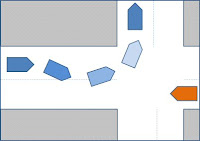
My advice is to be especially cautious when approaching an intersection where cars coming towards you could be turning left. The illustration on the left (imagine you’re driving the red car) shows what you probably expect to happen. What actually happens,  is that the drivers opposite, when making their left turns swing out to their right side and then make their way around the corner as shown in the right-hand picture (you’re still in the red car and your clear lane just got smaller.)

Every country has them, but in England they’re universally called Boy Racers. These are the, usually young, drivers have two defining characteristics: First, they cannot abide following another car going at the speed limit or below; second, they cannot resist the adrenalin rush of passing on blind curves.  It’s long been a curiosity to me why nobody seems to be concerned about the obvious gender bias in the name Boy Racer.

A variation on the Boy Racer, or maybe a sub-set, is the white van driver. For those not familiar with English traffic, most trades such as plumbers, carpenters, gardeners, etc. drive around for their work in small to medium white vans. They are always in a hurry to get to the next job or delivery, or the nearest pub for all I know. Other road users are well advised to observe the same caution with white van drivers as with Boy Racers.

The opposite of the Boy Racers are the elder drivers. (I must come clean hare and confess that I am something of an elder myself, although hopefully not an “elder driver”.) For some reason most elder drivers own the smaller models of Volvos, so they’re easy to spot. These cars come equipped with a speed governor, maybe just a block of wood taped to the underside of the accelerator pedal. This device limits the Volvo’s speed to 30 miles per hour regardless of the legal or safe limit on the road. The most fun is to be had watching a competition between and elder driver and a Boy Racer approaching a blind curve.

Herefordshire is a very rural county and the predominant local industry is agriculture. A lot of apples and potatoes are grown around here. For historical reasons, most English farms are made up of fields that are not next to each other. One farmer’s land can be scattered over several different fields that can be quite a distance apart. To get on with the business of farming the farmers need to move from one of their fields to another with some considerable frequency. Now, tractors are designed to be powerful rather than fast. I think the newest models are able to move along the highway at a maximum speed of about 40 mph, and older ones are slower. The result is that long tail-backs are very common on the main roads where the speed limit is 60 mph. As these parades make their way along our curvy roads, the Boy Racer and white van drivers can be depended upon to keep the situation from becoming boring.

Kosher Dill Pickles

I suppose that most people living away from their birth country miss some of the foods from “home”. For me it was hamburgers and kosher dill pickles to go with them. In butcher shops and restaurants they sell things called hamburgers, but they’re not real hamburgers. We go to very good butcher in Ludlow and they have hamburgers labelled 85% beef. Come on!

Susan has solved the hamburger problem by buying good rump steak and grinding it up at home. With high quality meat, these are really good burgers. But kosher dill pickles are nowhere to be found, at least not around here in darkest Herefordshire. Last year, Susan once again came up with the solution: she grew pickling cucumbers in the community garden and we found a good recipe on the internet. This recipe was from an American woman living in New Zealand who had the same problem as me.

I’m no cook, but I followed the directions and the results were almost like a New York deli. Thank you nice American woman in New Zealand.

Wednesday, 2 November 2011

Confused About Time

Every few years (it seems like five to eight years) the incumbent government of the UK proposes to study the possibility of changing the British time zone to that of continental Europe, i.e. one hour ahead. This week the current government has done exactly that. Whenever this happens, the people of Scotland, especially farmers, protest that it would be bad for them.

Right now Britain has Greenwich Mean Time (GMT) from the last Sunday in October ‘til the last Sunday in March. The rest of the year we have British Summer Time (BST), which is one hour later. Ireland and Portugal are the only other European countries in this time zone. The rest of Western Europe, up to a north-south line running from Finland to Greece, is one hour ahead of British time all year round.

The Scottish augment rests on the fact that they are very far north, and so their days are shorter than English and Welsh days. They complain that the farmers in Scotland would have to milk their cows in the dark; kids would have to walk to school in the dark and would therefore get run over by cars more often; and there would be a lot more traffic accidents. I guess that the Scots have a pretty low opinion of their own ability at night driving or maybe they believe that English drivers, not used to driving after dark, would be knocking off the Scottish kids walking to school. (Someone should do a study the ratio of child-on-the-way-to-school accidents in Norway and Italy.)

All this time business has always confused me. I’ve never really understood why the time has to change from winter to summer anyway. It would work just as well if schools, government offices, businesses and shops just opened and closed at different times to give people extra time for their summer evening barbeques. This concept applies even more dramatically to farmers! Before times were standardized in the nineteenth century, farmers must have milked cows when it was convenient or when the cows needed to be milked. These farmers didn’t need some official time to get their work done. It’s beyond me why present-day Scottish farmers aren’t able to organize their work in the traditional way. But no; if the government in London says that it’s seven or eight in the morning, then that’s when you have to milk your cows, dark or not.

There’s another angle on this: why does Scotland have to be in the same time zone as England? If the two ends of the Channel tunnel can exist quite comfortably being an hour apart on the clock, why can’t Scotland and England also be an hour apart. Nobody in The British government or the Scottish complainer ever brings this up.

Or here’s yet another idea: if the whole world was just one time zone, then people in different places, north or south east or west, would pretty soon arrange things in the most convenient way. Some farmers would milk their cows at midnight on the clock and others would milk at noon.

These are a few of the reasons why I’m confused about time.